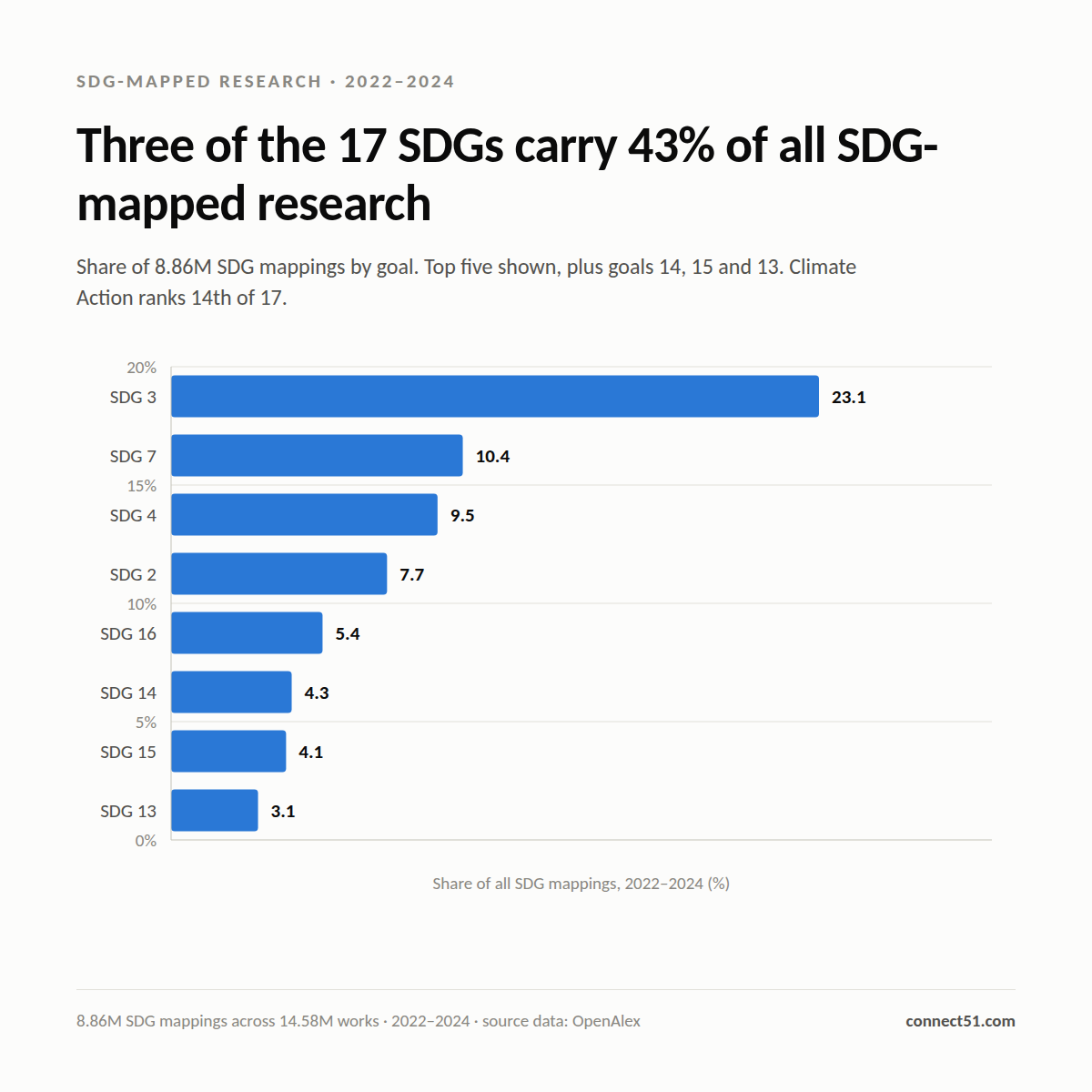
Three of the 17 Sustainable Development Goals account for 43% of all SDG-mapped research output published between 2022 and 2024.
Three of the 17 Sustainable Development Goals account for 43% of all SDG-mapped research output published between 2022 and 2024. Good Health and Well-being alone takes 23%. Climate Action sits 14th of 17, at 3.1% — behind Life Below Water and Life on Land.
That matters when you are benchmarked on SDG volume. The classification base is overwhelmingly health, energy and education research, so a climate-led institution can look thin next to a medical school without producing less. Worth knowing which denominator your ranking submission is competing in.
If you want the same 17-goal split for your own institution, we run free Connect51 trials for research offices — drop a comment or DM me, or start at https://www.connect51.com
#Connect51 #ResearchManagement #ResearchImpact #OpenAlex #Bibliometrics
See more →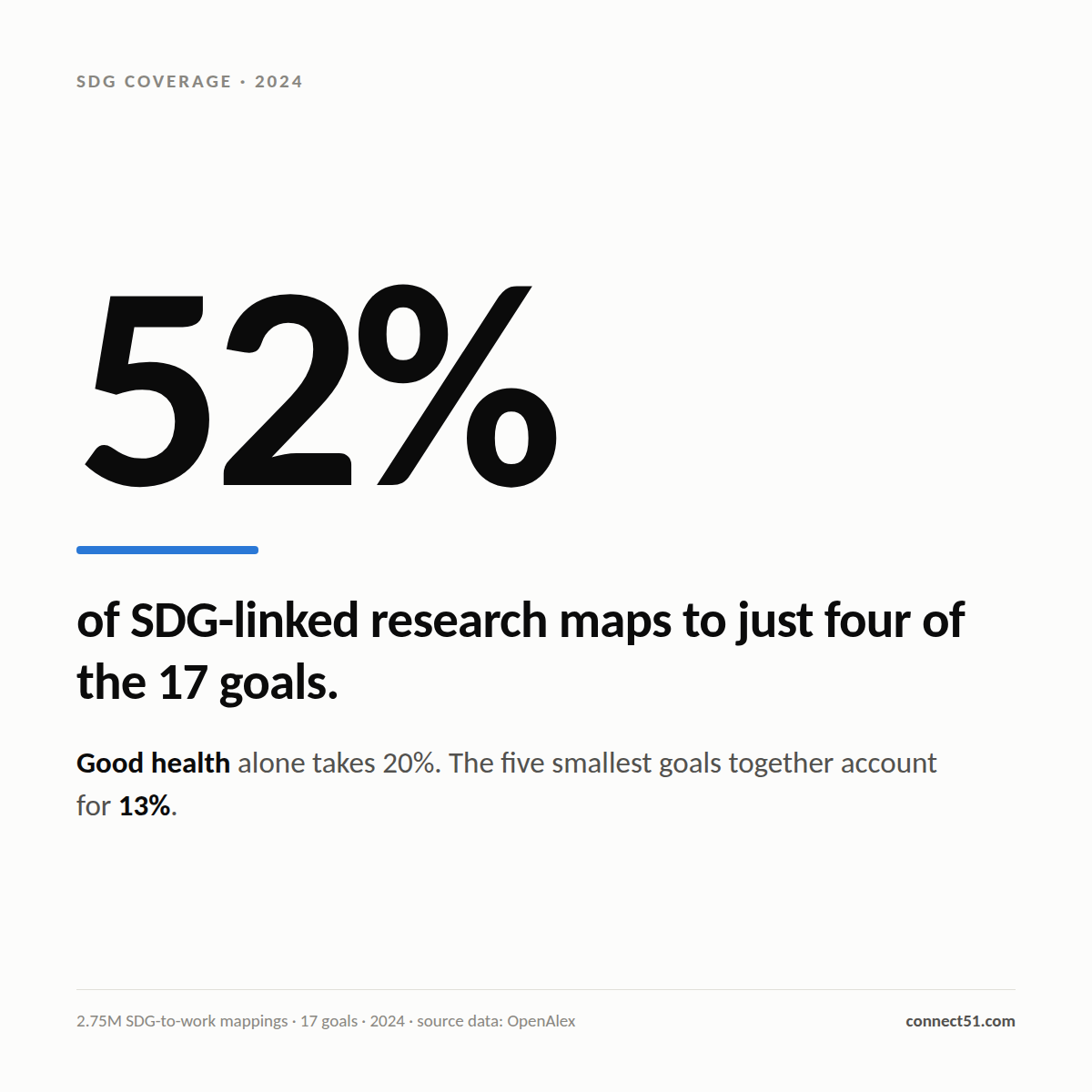
In 2024, four of the 17 Sustainable Development Goals absorbed 52% of all SDG-linked university research output.
In 2024, four of the 17 Sustainable Development Goals absorbed 52% of all SDG-linked university research output. Good Health alone took 20% — nearly four times the combined output of No Poverty, Partnerships and Responsible Consumption.
For a research office, this is the gap between an SDG portfolio and an SDG strategy. Most SDG profiles are a by-product of where medical and agricultural strength already sits, rather than a deliberate choice. The thinnest-covered goals are also where a mid-sized university can still be visible.
If you want to see how your institution's SDG mix compares with this global distribution, we run free Connect51 trials for research offices — comment or DM me, or take a look at https://www.connect51.com
#Connect51 #ResearchManagement #ResearchImpact #OpenAlex #Bibliometrics
See more →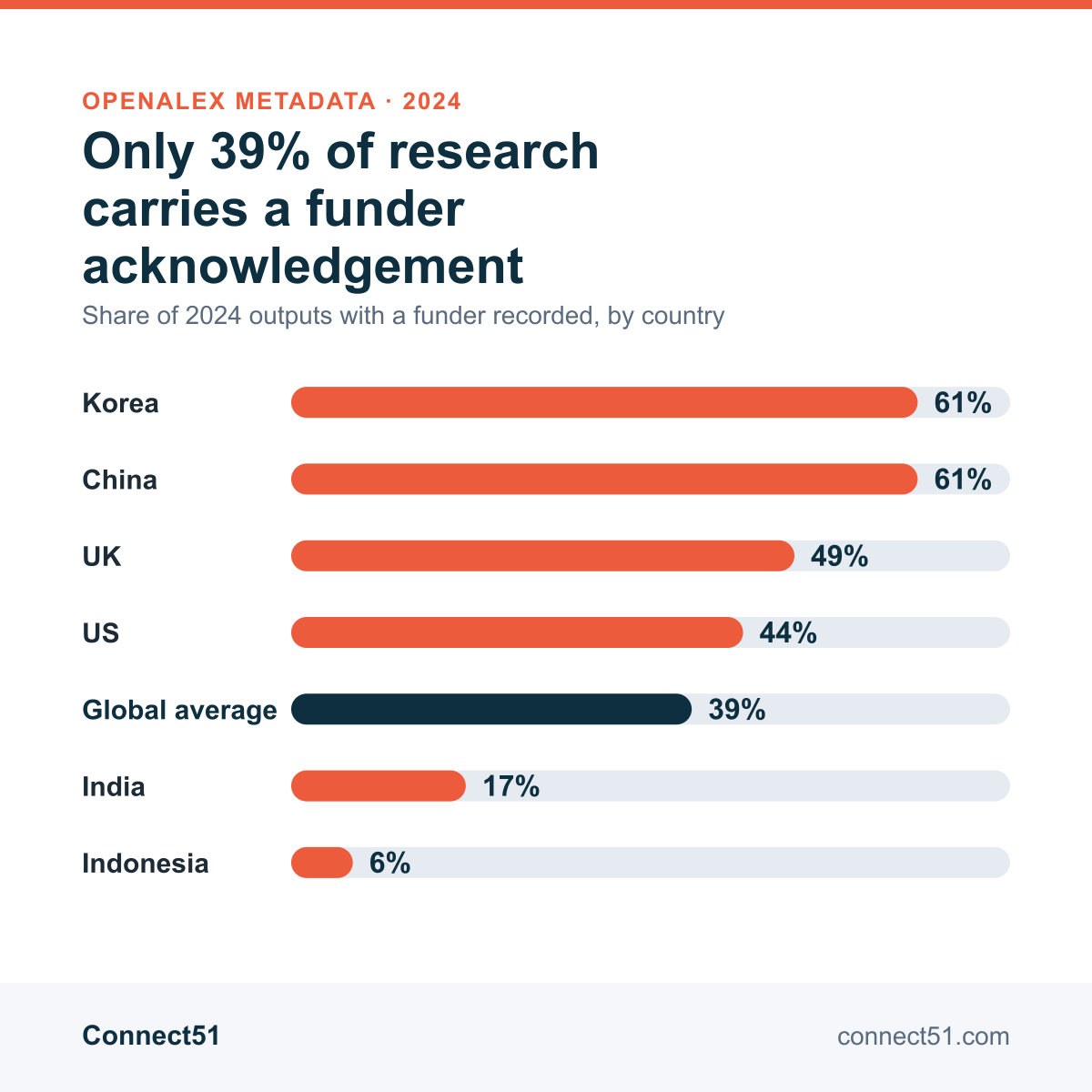
Only 39% of research carries a funder acknowledgement
Only 39% of university research published in 2024 carries a funder acknowledgement in its metadata. The other 5.5 million outputs name no funder at all, and that share has not moved since 2021.
The gap is national rather than disciplinary: Korean and Chinese universities record a funder on about 61% of output, the UK 49%, the US 44%, India 17%, Indonesia 6%. If your funded-output reporting rests on this metadata, you are undercounting your own grant returns, and any international benchmark is partly measuring acknowledgement practice rather than funding.
Worth knowing your own acknowledgement rate before the next impact return. We run free Connect51 trials for research offices, so comment or DM me, or take a look at https://www.connect51.com
See more →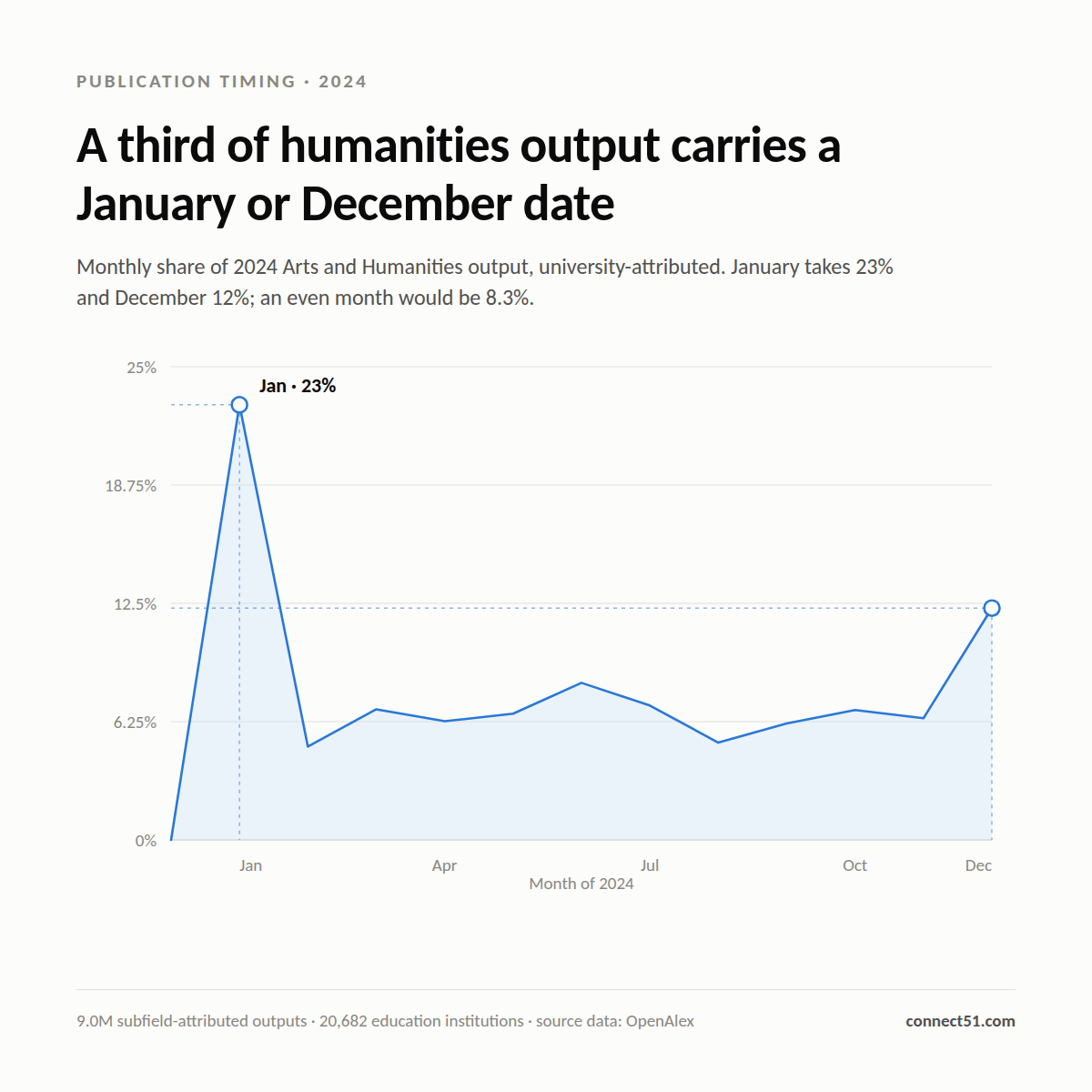
Across 2024, 35% of university Arts and Humanities output carries a January or December publication date.
Across 2024, 35% of university Arts and Humanities output carries a January or December publication date. In Health Sciences it is 22%. An even spread would put both near 17%.
That gap is metadata convention, not a year-end rush: year-only and issue-only dates default to the year boundary, and humanities journals use them far more. If your office runs a census date or annual return off publication date, you are mis-timing humanities output against STEM.
Want to see how your own disciplinary mix skews date-based reporting? We run free Connect51 trials for research offices — comment or DM me, or visit https://www.connect51.com
#Connect51 #ResearchManagement #ResearchImpact #OpenAlex #ResearchOffice
See more → Danielle SwanepoelExecutive Director of International Relations and Strategic Initiatives
 Kunnikar KanatharanaStrategic Advisor - University Rankings